… And Other Language Gaffes from a Late Beginner
For the record: I did not eat the cat. I want to say that immediately before this entry goes any further.
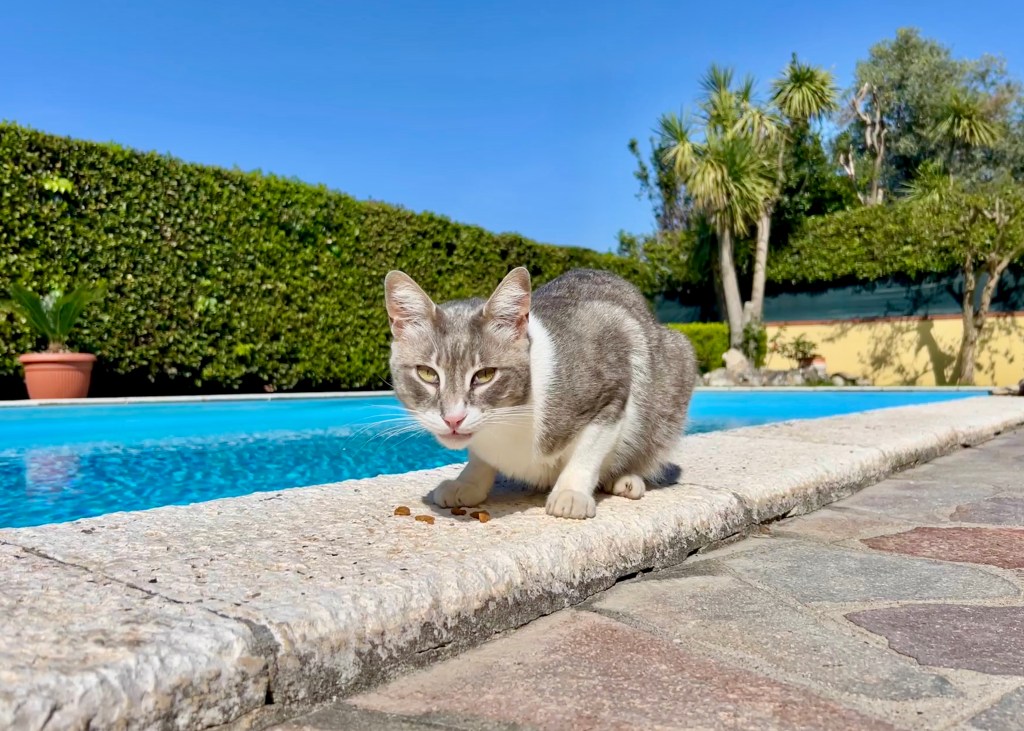
I did, however, tell my neighbor that I had. What I was trying to say was that I left out treats for the strays in our neighborhood. What came out, in Italian, was that I had eaten her cat.
There is a particular kind of silence that follows a truly spectacular mistake. The held breath. The moment when everyone in the room processes what just happened and nobody knows what to do with it. That was my neighbor’s face.
Under the Brambilla Law, which came into effect last July, cats are legally protected sentient beings and harming one can carry up to four years in prison. My comment could have turned out to something considerably worse than bad grammar.
I could not bring myself to repeat it in class. My Italian teacher has show cats, and it seemed such a confession would require a relationship that my two weeks of instruction had not yet built. I filed this experience away as one of my many contributions to the long, undignified tradition of people who work with what little they have and produce something they absolutely did not mean.
This week, a simple noun tripped me up. The exercise was to describe the classmate sitting to our left. The woman next to me studied marine biology with a focus on fisheries, in which I took a particular interest since my teenage son wants to go into that field.
I worked with what I had. I did not know the word for marine. Or biologist. Or fisheries. What I did know was fish, pesce, which I used with complete confidence. In Italian slang, however, pesce in the singular, paired with the verb and tense I used, does not describe marine life. Instead, it describes a male body part that has no business appearing in an explanation of someone’s academic credentials. My teacher and classmate received my latest blunder with considerable grace. We moved on.
* * * * * * * * * * * * *
are separate things
On the cusp of my “third third” in life and twlight tour in the Navy, I have three years in Naples. I will supervise Italian nationals and work alongside local religious leaders. The least I can do is try to meet the people with whom I will serve in their own tongue. For decades, other people have done the work of translating, adjusting, and polite pretending that my half-gestures somehow counted. When one language opens doors, it is easy to forget that someone else had to hold it.
My spouse is trilingual, and we have tried to impress upon our children the importance of knowing more than one language. There are U.S. parents who hold the line against the cultural gravity of a monolingual country, and they are doing something genuinely hard against considerable odds. I admire them. Our children still live under our roof, and though neither has fully claimed a second language yet, there is still time.
I come to Italian with essentially nothing. Musical notation gave me fortissimo and andante and very little else useful for a grocery store. My vocabulary is three weeks old and it shows. My grammar is younger still. And then there are the c sounds — ka, ke, ki, cha, che, chi — six variations on a single letter, each one a small trap I fall into with impressive consistency.
Most days in class I am on the verge of tears. I am twice, nearly three times, the age of most of my classmates and a few of my instructors. And then there are the women at the school who are my age, polishing what is for them a fourth or fifth language, while I am here barely scraping at level A1.
I cannot say what I mean, and I cannot understand what anyone else is saying. English is my native language, and I have spent decades inside it, studying its etymologies, its idioms, the precise weight of one word over another. I go for the pun hiding in plain sight. At my best, on the page, I can end a sentence the way Simone Biles ends a routine. In Italian, I am starting from nothing, and I wonder if the person I am in English will ever find her way into this language.
I am shy about speaking. In Italian, Spanish, even English. People who know me from the pulpit might find this hard to believe. What they are not likely to know is that I stuttered as a child, badly enough that it still lives in my body, a low hum of anxiety that surfaces the moment I have to produce language without a net. I preach from a manuscript. I studied improv theater specifically to learn how to speak without one. Improv helped, mostly. Italian has no such cushion. There is no scene partner to save me when my mouth goes rogue and I just told my neighbor I ate their cat.
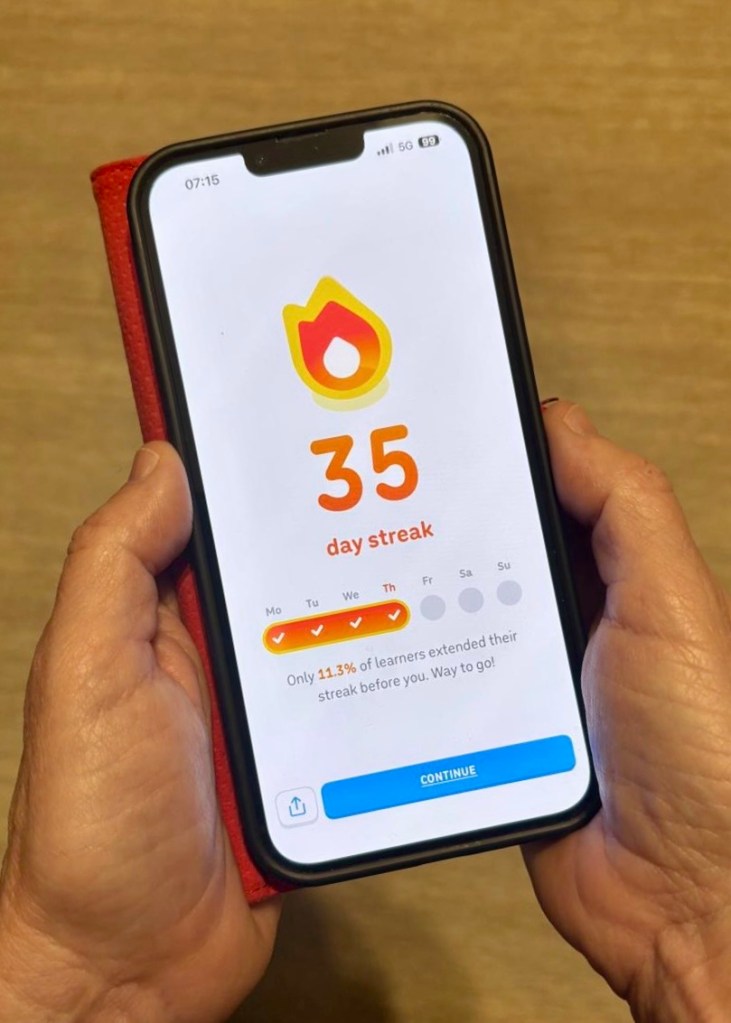
Another reason why I’m doing this: dementia runs in my family. Research suggests that learning a new language builds the kind of neural resilience that may slow cognitive decline. I start my new job next week and will trade four hours of daily instruction for weekly tutorials, with Duolingo and Jumpspeak filling the gaps. I do not know if conjugating irregular verbs will keep my mind sharp as I age. I choose to believe it will. The alternative is to do nothing, and I have already tried that.
* * * * * * * * * * * * *
Last week, the Artemis II crew returned from ten days circling the moon, farther from Earth than humans have gone in more than fifty years. They watched Earth shrink into a small bright point against all that black. What struck Astronaut Christina Koch as much as the beauty of it was the crew. A crew, she said:
“is a group that is in it all the time, no matter what, that is stroking together every minute with the same purpose, that is willing to sacrifice silently for each other, that gives grace, that holds accountable…and is inescapably, beautifully, dutifully linked.”
Standing on the ground in Houston, still finding her legs in gravity, she looked out at the crowd and said: “Planet Earth: You. Are. A. Crew.”
That is what learning another language is. A gesture toward the people who have always been doing that work without you. I am late to it. I am bad at it. I am showing up anyway, one imperfect gesture at a time, because a crew needs everyone rowing, even the one in the back who just inadvertently described a marine biologist’s entire field of study in terms that made this sailor blush.
My instructor’s show cats finished second this past weekend. The neighborhood strays are still on my doorstep, alive and well. Everyone, every being, will be fine.
Piano, piano.
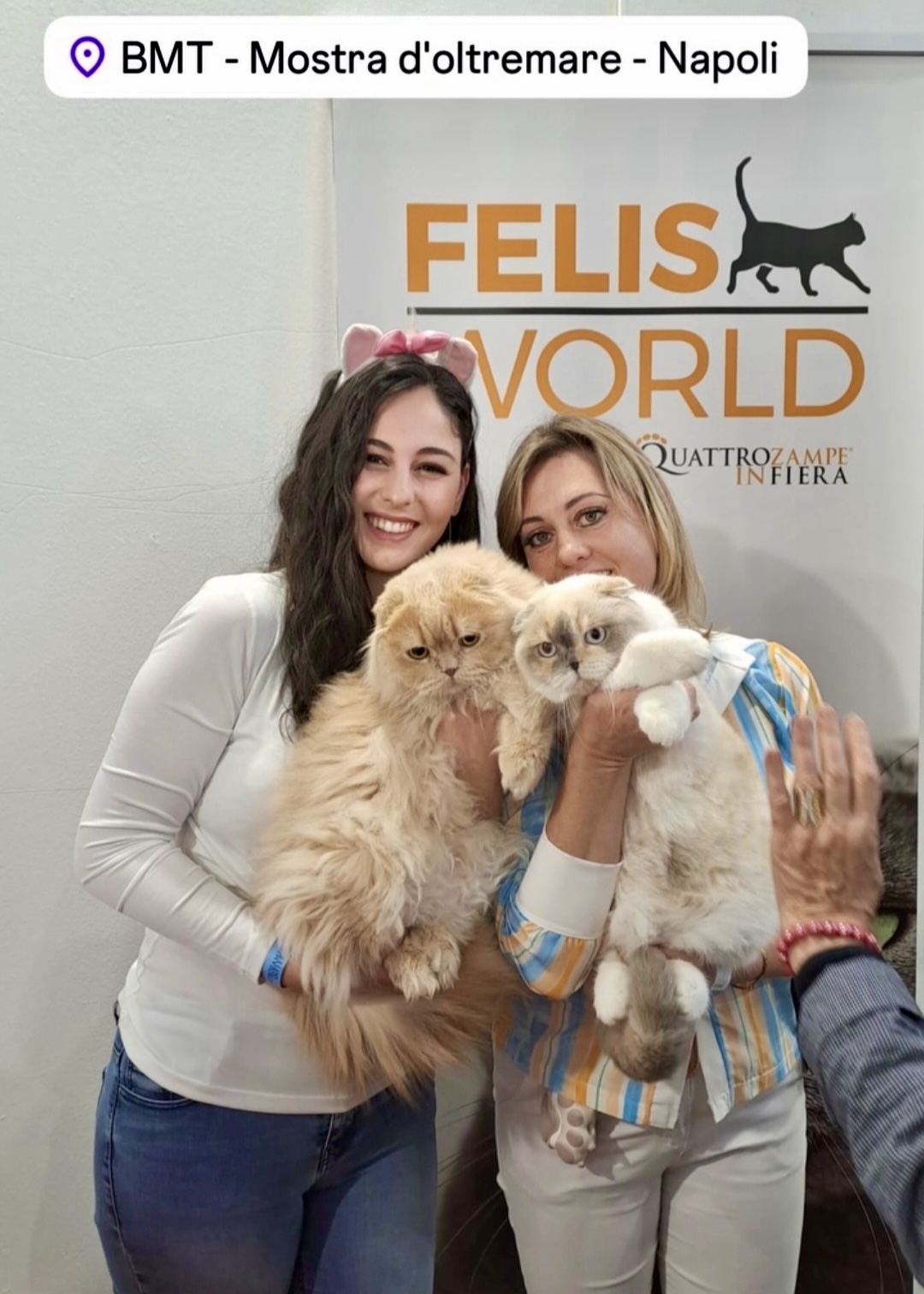
I can only hope someday I am ready for show.


Leave a Reply