It has been nine years since I last wrote here. In that time, we have crisscrossed the country and oceans, raised astonishing young humans, witnessed the weaving of new family through marriage, and cradled the beginnings of another generation. We have ministered to the living and the dying, served amid tumult and peace, earned degrees, and moved our households across new landscapes. Life in full measure. Poured out. Shaken. Stirred. Offered up.
At this moment, what brought me back to this page aren’t the great migrations or milestones these past years. It was a family game night and a round of Life. In it I found a mirror quietly held up to the human spirit.
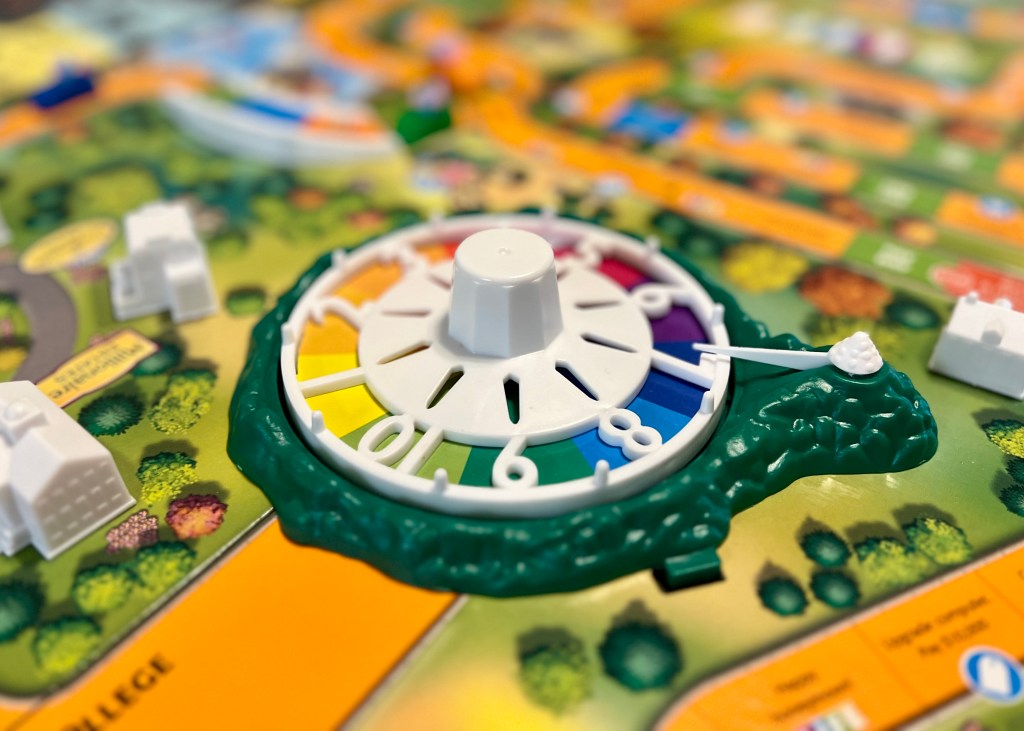
It was an ordinary family evening. We pulled out the pastel-colored spinner and the plastic cars. Chose our pegs and our paths. College or career? House or no house? Family of four, or stay the course solo? We played along, half-heartedly, chattering about our day between spins.
The early stage of the game brought us amusement as we watched our tiny cars hurtle along the prescribed path, gathering salaries and Life cards like souvenirs. A baby here, a promotion there, a car accident, an insurance payout. All randomized, all impersonal. Our plastic avatars experienced a flurry of events, all disconnected from us.
And then a silence fell over the table. We realized, we were bored.
Bored, and a little disheartened.
Because the goal, it turns out, is simply to retire with the most money. Not to live a life of purpose and meaning. Not to forge the deepest friendships. Not to weather heartbreak and come out braver. Not to love with such ferocity that our plastic peg hearts might crack open. Just…to accumulate.
Life, the game, distilled living into its most unappealing aspects. Random external events. Keeping score. Chasing a finish line no one genuinely looks forward to.
And there, in our tiny cars, we could see the truth. No wonder so many of us feel so exhausted. We are living a game we don’t even remember choosing.
* * * * * * * * * * * * *
The board game’s version of life promises a neat progression. First college, then career. First marriage, then mortgage. First tiny pink and blue pegs for children, then bonuses and Life cards, and finally retirement.
This is a script so deeply embedded in our culture it has become invisible. Both as communities and as individual, our culture defines progress as forward motion, stability as the greatest good, and retirement as the final reward for a life spent well…or at least, spent.
Playing it out (even in miniature) felt hollow.
Because real life rarely follows a predictable pattern. The key to success lies in being resilience. In being devoted. In standing still at the crossroads of grief and hope. In our hearts cracking open and pouring out so love, justice, wonder can flow through us. We must be broken and reassembled into new, wiser shapes.
The moments that shape us are not the result of spinning a wheel and moving forward six spaces.
They happen when we stand still and ache.
They happen when we make costly choices with no guaranteed payout.
They happen when we lose, and somehow, find something more precious in the losing.
Beneath the board game’s shallow victories stirred a deeper reckoning. What does it mean to live? Not merely to survive, not merely to succeed, but to offer ourselves to something larger than the pursuit of gain?
The true “paydays” are not measured in salaries or properties. They are the moments of connection and courage. When we choose generosity over self-preservation, tenderness over expedience. When we stake our lives on something that may never show up on a balance sheet.
The true “Life cards” are not vacation homes or windfalls. They are the invisible legacies we hand to one another, those unseeable bonds that transfer wisdom, compassion, memory, and resilience between each other. They are the intangibles that survive fire and flood, recession and exile.
And the real “retirement” (if there is such a thing) is a passage. A surrendering of some burdens, an acceptance of new ones, a deepening rather than a disappearance.
The concept of living as transformation instead of accumulation forces us to ask what faithful living demands from us.
What would it mean to lose at Life?
Or more radically, what would it mean to refuse the game altogether?
* * * * * * * * * * * * *
The great spiritual traditions focus more on teaching us how to live well without winning rather than teaching winning strategies.
In Christianity, Jesus tells us: “For what will it profit [a person] to gain the whole world and forfeit their life?” (Mark 8:36, NRSV) In Buddhism, the path demands the abandonment of self because true victory requires the elimination of the self that seeks triumph. In Taoism, the river changes the rocks, as the rocks are carved into beauty through yielding.
The goal is beyond accumulation. Beyond arrival. The goal is transformation.
Transformation happens precisely in the breaking. The true measure of our existence emerges from what spills out from us — truth, tenderness, strength — when the false game collapses.
Our life-defining moments are not the ones where we earned a “Life card” or collected a bigger salary peg. They are the moments that stripped us bare.
Deployment goodbyes, when our hearts were raw wounds.
Childbirths, messy and terrifying and holy.
Middle-of-the-night ministry calls, cradling grief we could not fix.
Moves that left us lost and lonely in new places, praying for a hand to hold.
In these moments, we didn’t win anything. We were not even moving forward. We were simply being made. More porous, more tender, more awake.
My goal is to teach my children (and myself) about living the game of Life instead of teaching them to win it. How to livewhen the game itself seems wrong. How to be generous in a world obsessed with taking. How to be vulnerable in a culture obsessed with winning. How to be faithful to love, even when it costs more than we dared to imagine.
Because this fierce, fragile living is the only kind of “winning” that matters. To live so deeply and courageously, that even if we lost by every measure the world holds dear, we would still count our lives a victory of grace.
* * * * * * * * * * * * *
We played the board game to the end that night. We counted our Life cards, our bank accounts, our assets.
And then we looked at each other, a little sheepish. We put the spinner away. And we stayed up a while longer, just talking. Telling stories. Laughing at ourselves and with each other.
No pegs. No paydays. No winning. Just this: a messy, unspinnable, glorious life.
And that is the real game.
 Captain Reverend Mother
Leave a comment